

If you’re currently in the grips of anger and grief, this particular post might not be for you just yet (but come back when you’re ready).
If you’re anything like me, you’re more angry at yourself at this point than you are at the people who mistreated and hurt you. While their treatment of you is not your fault, you probably internalized it, and learning how to forgive yourself is key to un…internalizing it? We’re making that a word.
You might have behaved in a way you thought they wanted – that would pass the test, over and over again. You probably treated yourself poorly by moulding or shaving off corners of yourself to be someone else. Someone who took less space, didn’t laugh as loud, wasn’t as goofy and free, and who wasn’t confident. Someone who did themselves the disservice of crawling on all fours for scraps of approval and affection.
You might think back and feel immense shame and extreme anger at yourself for ever having become such a “pathetic” version of yourself (that’s Trauma Brain talking).
You might wonder how to forgive yourself when the anger just won’t loosen its hold, day after day. It’s important to try – for all the months or years you lost putting yourself last (no judgement here). Here’s what helps me, Stoics and poets included.

This comes back to what I noted above. There are different stages of healing and if you’re actively grieving and ugly crying, this isn’t the time to “work on yourself” (in my opinion). All that will end up happening is that you’ll blame yourself even more and get even angrier and hopeless. That’s not what we’re after.
The kind of mindset that is ripe for forgiveness work is one where you’re finally just tired of your own (and Trauma Brain’s) crap. You’re just DONE with remembering what you said or did in middle school and feeling a wave of shame, stupidity, and “less than”-ness. You’re tired of taking accountability for sh*t that isn’t yours to own. You get frustrated when you feel bad about yourself at the memory of who and how you were as a direct result of someone else’s evil and audacity.
In short, you’re ready to free yourself from the cage of self-doubt and hatred.
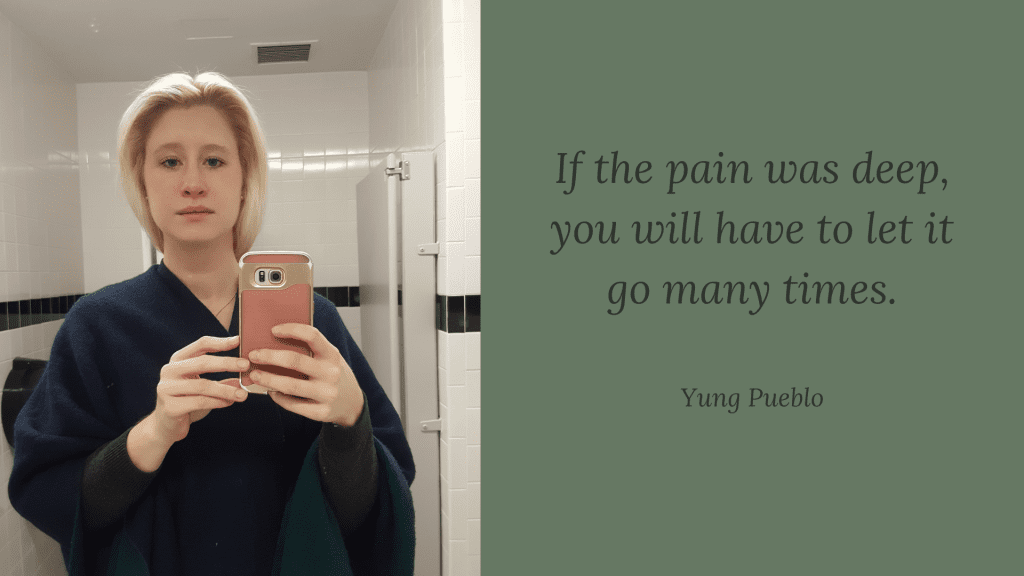
This helps me frame forgiveness as a continuous process. That means that if I find it hard to forgive myself now and then, it doesn’t mean I’ve “failed” at forgiveness. It’s ongoing and there’s something beautiful and restorative about that. It means I’m actively choosing myself, again and again, something neither of us have done in a long time.
Every single time you remember, send love to that part of you and forgive yourself. Forgive for whatever you think you said or did wrong, for who you “should have” been or “should be” now but aren’t. We’re all a work in progress and there’s no shame in that.
Anyone who says differently can go fly a kite.

I’m a big proponent of showing others kindness. That can look like hyping someone up and complimenting an outfit (including guys, which I realize gives the wrong impression most of the time), letting someone know I’m thinking of them, helping an older person sit down on a moving train, etc. It costs nothing to be kind.
So why do we lift up others while simultaneously tearing ourselves down?
Usually, it’s because that’s what we’re used to. We might have been “othered” for so long, been in terrible relationships, have had family issues, career issues, etc. Add to that the messages that we, as girls and women, have received since we were little: we need to close our legs in public, not wear short skirts or low-cut tops, not be “bossy” (code for assertive), too athletic, too loud, “unladylike,” and to, in general, take less space. We’re told, over and over in various ways, to be likeable, read the room and shapeshift accordingly, and become what other people want.
We lose ourselves before we become anyone at all.

What happens when we step a toe out of line? We’re met with criticism, bullying, groundings, beatings, public humiliation (usually by authority figures), in some cases death, are kept out of corner offices, and other penalties. What do we do to avoid such blowback? We adopt a “safety first” mentality.
When we choose “safety first,” our minds go into a kind of “all hands on deck” scenario. When this happens, we chase who we should be (i.e. the gospel according to everyone but you). We chastise ourselves for our transgressions – things we’ve said or haven’t said, did or didn’t do, wear or didn’t wear, pay for or didn’t, etc. So while we might be kind to others, we’re absolute dog sh*t to ourselves. And that’s not even adding on trauma, that’s just the life of a woman.
And aren’t you tired of it? Because I definitely am. Learning how to forgive yourself requires kindness as an antidote.

We can’t rush healing and I’m by no means trying to stress you or make you feel worse for not having started sooner. I had a guided journal once that was titled, “Start Where You Are” and that’s true. If you’ve come this far down the post, then you’re probably interested in how to forgive yourself. What I mean by “don’t delay” is that we so often get overwhelmed by the effort our minds tell us it takes to show ourselves kindness in times when it’s hardest to do so.
We might procrastinate, feel like we’re too busy or even having too good of a daily life right now to sabotage it by thinking about bad things. But I’m not saying to go ruminate over bad thoughts and feelings. What I’m talking about is incorporating the practice of sending yourself kindness and love. You need it most whenever bad or difficult thoughts, feelings, or memories come up. And it is a practice, not a cure-all “I love myself so much!” and then everything is fine. Like I said earlier, it’s an ongoing process, and it’s worth incorporating into your life.
The reason I love this quote is because we, as both women and trauma survivors, rarely “demand the best for ourselves.” Heck, we rarely “demand” at all! I want you to ask yourself this question out loud. Include your name.
In other words: “Anna, how long are you going to wait before you demand the best for yourself?”
Add some loving attitude in there for good measure, à la Alethea Crimmins. I’m not even kidding. Speaking to yourself out loud like you would to a friend really reframes the situation because you’re no longer just thinking stuff to yourself. Your ears, mind, heart and soul are hearing what they need to hear from the most important person right now – YOU.
You are showing up for you and that is exactly the support you need.

There are many ways to check in with yourself when you’re triggered. Do you need to send some love to your inner child, physically remove yourself or leave a conversation, or need to get your heart rate down?
What I’d like to propose given the theme of today’s post is asking yourself this:
“Am I angry at them, or at myself?”
The waters of anger and hurt are thick and muddy. Checking in with yourself in this way helps to clear them a little because it leads us to follow our reaction back to its source. Not only does this (hopefully) keep us from exploding on a relatively innocent individual, but it brings our attention to the root of the problem so that we’re more aware of what’s causing our strong reaction.
You might be thinking, “Oh yay, more self-awareness, great, that’ll fix it.”
Well, no, but if you can identify why you felt triggered it can help in preventing a flare-up later that day, say, when you speak to your significant other or roommate. I’m a big fan of transparency and communication. If you know something triggered you earlier, there’s a risk a similar thing might trigger you again later that day (because our minds and emotions are a hot mess). Preventing that by communicating that you’re feeling sensitive about X topic, for instance, can go a long way in maintaining relationships.
And how many relationships haven’t gone tits up already?
To be clear: the focus and benefit of knowing who you’re angry with and whether you feel you owe yourself an apology is the emphasis. How it affects others is a bonus.

I would also like to take this opportunity to say that I take major issue with the “4 Rs of Forgiveness,” which has slight variations but looks like this model and this other model. I prefer “recognition” over “responsibility” because the way they frame “responsibility” in this model only seems to, in my view, add to the guilt and victim-blaming.
The text under “Restoration” in the second link even goes so far as to say that apologizing to others “takes away the feeling of wishing you could have done more,” which is just complete and utter bullsh*t. Also, why is it talking about apologizing to others when the topic is self-forgiveness? Anyway, I find a lot of these “models” or “frameworks” are just bumper sticker templates that don’t actually help very much or worse, actually lead survivors feeling guiltier than they already are.
How you behaved and survived in a destructive and/or traumatic situation is not your fault. There’s a difference between accountability and assigning blame.
Let’s not do the latter.
Navigate
Location
I’m based in Stockholm, Sweden.
Sign up for my weekly newsletter to get all the good stuff straight to your inbox (no spamming).
© 2025 Braving Shadows | Privacy Policy